1/12/2026. If you've ever spent time manually solving hCaptcha challenges, you know how tedious it gets. An
hCaptcha solver can handle these automatically, freeing you up for more important work. The solver options in 2026 includes AI-powered recognition tools, human-based services, and behavioral simulation techniques. We're going to compare how they stack up on accuracy, speed, and cost so you can make an informed choice.
TLDR:
- AI solvers achieve 95.93% accuracy solving hCaptcha in 18.76 seconds on average.
- Human-powered services cost $1-$3 per thousand solves with 98%+ accuracy rates.
- hCaptcha tracks mouse movements and click timing to detect automated behavior patterns.
- Roundtable verifies users through behavioral biometrics without interrupting your visitors.
What is hCaptcha and How Does It Work
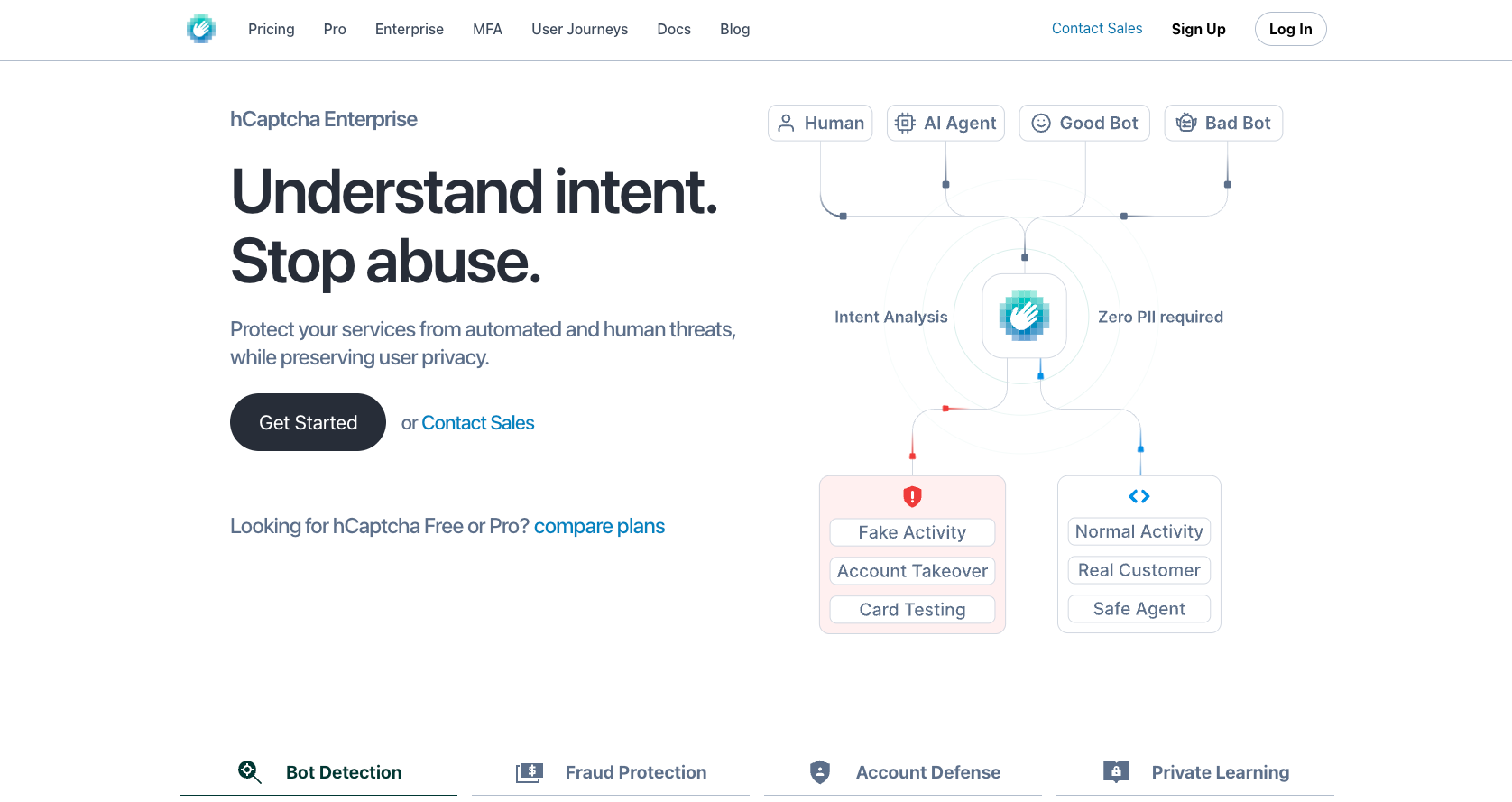
hCaptcha is a security service that presents interactive challenges to verify whether you're human or a bot. When you encounter hCaptcha on a website, you'll typically see a grid of images asking you to identify specific objects like traffic lights, bicycles, or storefronts.
Behind the scenes, hCaptcha does more than just check your image choices. It tracks how you move your mouse, the timing of your clicks, and subtle behavioral patterns that distinguish human users from automated scripts. The service also collects device fingerprints and browser signals to build a risk profile for each visitor, using
bot detection methods to distinguish automated traffic from real users. What makes hCaptcha particularly challenging to bypass is its combination of AI-powered image recognition and behavioral analysis. The system continuously updates its image dataset and adapts its detection algorithms, making it harder for bots to predict and solve challenges consistently.
Types of hCaptcha Solver Methods Available
When you need to solve hCaptcha challenges programmatically, several distinct methods exist, each with different tradeoffs in accuracy, speed, and cost:
- Human-powered services route CAPTCHA challenges to real people who manually solve them. These services use workers across different time zones who handle challenges in real time, returning solutions within seconds.
- AI and machine learning solvers use computer vision models trained to recognize patterns in image challenges. These tools attempt to replicate human visual recognition, though their success rates vary depending on challenge complexity.
- Browser automation frameworks like Selenium or Puppeteer can be combined with solving services through APIs. These tools simulate human browsing behavior while integrating with external solvers to handle CAPTCHA prompts when they appear.
- Behavioral simulation approaches focus on mimicking human interaction patterns instead of solving challenges directly. These methods aim to avoid triggering CAPTCHA challenges altogether by replicating authentic mouse movements, typing patterns, and navigation behaviors.
Let's look at each of these methods.
Human-Powered CAPTCHA Solving Services
Human-powered CAPTCHA solving services use a crowdsourcing model. When you submit an hCaptcha challenge through their API, a worker manually identifies the correct images and returns the solution. These services maintain global workforces across time zones for 24/7 availability. Workers earn small payments per CAPTCHA solved, keeping response times relatively quick despite manual processing.
Human workers achieve near-perfect success rates because they can interpret ambiguous images, understand context, and handle edge cases that confuse AI models. Response times typically range from 10 to 30 seconds per challenge. Popular services include 2Captcha, Anti-Captcha, and CapMonster. Pricing sits between $1 to $3 per thousand solved CAPTCHAs.
AI and Machine Learning Based hCaptcha Solvers
AI-powered hCaptcha solvers use computer vision models trained to recognize and classify objects within challenge images. These systems typically rely on convolutional neural networks (CNNs) to process visual data and architectures like YOLO (You Only Look Once) to detect specific objects in real time.
The process feeds challenge images into trained models that identify target objects with high precision. Research shows that
YOLO v3 achieved 98% accuracy in solving hCaptcha challenges, completing each one in an average of
3.5 seconds. These models learn from massive datasets of labeled images, continuously improving their recognition capabilities.
But AI solvers struggle with ambiguous images, unusual angles, or challenges designed to confuse machine vision. As hCaptcha updates its image sets and introduces new challenge types, these models require constant retraining to maintain effectiveness. Human solvers still outperform AI in edge cases where context or subjective interpretation matters.
Browser Automation and Behavioral Simulation
Browser automation tools like Selenium and Puppeteer can mimic human interaction patterns when encountering hCaptcha challenges. These frameworks introduce randomized delays between actions, vary mouse movement trajectories, and simulate natural scrolling patterns. Sophisticated bots use behavioral simulation libraries that generate realistic cursor paths with acceleration and deceleration curves instead of straight-line movements. They add micro-pauses and jitter to clicks, replicating the slight imprecision of human motor control. Typing speed varies randomly, and mouse movements occasionally overshoot targets before correcting.
hCaptcha's detection
analyzes cursor movements, click timing, and user speed to identify non-human patterns. The service also tracks device fingerprints and IP reputation to flag suspicious sessions. Bots that solve image challenges correctly but exhibit unnatural interaction patterns still get blocked. Advanced automation setups rotate residential proxies, spoof browser fingerprints, and inject random browsing behavior before reaching protected pages. Despite these techniques, behavioral detection continues evolving to spot subtle indicators that distinguish scripted actions from genuine human interaction.
But there is a core limitation in this approach: Human behavioral patterns contain thousands of micro-variations that remain difficult for automation to replicate convincingly at scale.
API-Based Integration Methods for hCaptcha Solving
Regardless of the approach you choose to automate hCaptcha solving, most hCaptcha solver integrations follow a three-step API workflow:
- Extract the site key and page URL from the protected form, then send these parameters to the solving service's API endpoint. You'll receive a task ID in return.
- Poll the API with your task ID until it returns a solution token. This typically takes 15 to 60 seconds depending on the solver type.
- Inject the returned token into the hCaptcha response field on the original form and submit it. The protected site validates this token with hCaptcha's servers.
Many of the solving services provide client libraries for Python, JavaScript, PHP, Java, and C#. These libraries handle the polling logic and retries automatically. You can also use direct HTTP requests with any language that supports REST APIs.
Accuracy and Speed Comparison of Different Approaches
Performance varies a lot across hCaptcha solver approaches, helping you match the right method to your requirements:
- AI-powered solvers complete challenges fastest, typically finishing in 3.5 to 5 seconds. Accuracy depends on challenge complexity and image quality. Recent research shows automated systems solve hCaptcha with 95.93% accuracy at an average of 18.76 seconds per challenge.
- Human-powered services achieve accuracy rates above 98% because workers handle ambiguous images and context-dependent challenges that confuse AI models. Response times range from 10 to 30 seconds per solve.
- Behavioral simulation bypasses challenges by mimicking human patterns, but success rates fluctuate as hCaptcha updates its fingerprinting algorithms. For a detailed comparison of Roundtable vs hCaptcha bot protection, see how behavioral biometrics stacks up against traditional challenge-based verification.
For high-volume applications which require speed above all else, AI solvers deliver the best throughput. When accuracy matters most and delays are acceptable, though, human-powered services provide more reliable results.
Cost Considerations for CAPTCHA Solving Solutions
hCaptcha solving services charge based on volume, accuracy, and implementation requirements.
- Human-powered services typically cost $1 to $3 per thousand CAPTCHAs solved. Volume discounts apply at higher tiers, with enterprise plans dropping below $1 per thousand for millions of monthly solves.
- AI-based solvers run $0.50 to $2 per thousand due to automated processing. Factor in API integration costs and retry fees when accuracy drops.
- In-house behavioral detection requires upfront development investment but eliminates per-solve fees that scale with traffic.
Legal and Ethical Implications of CAPTCHA Bypassing
Bypassing CAPTCHAs exists in a legal gray area that depends on context and intent. Legitimate use cases include accessibility testing, quality assurance workflows, and authorized scraping where you have explicit permission from site owners.
The ethical line blurs when automation violates a website's terms of service. Most sites explicitly prohibit automated access, making unauthorized CAPTCHA solving a breach of contract even if not strictly illegal. CAPTCHA solving becomes clearly problematic when it allows for fraud, spam, credential stuffing, or ticket scalping. These activities often violate computer fraud laws and can carry serious legal consequences. Before implementing any hCaptcha solver, review the target site's terms of service and make sure your use case falls within acceptable boundaries. When in doubt, request permission from site owners.
Final thoughts on hCaptcha solver options
Your choice of
hCaptcha solver should match your specific requirements for speed and accuracy. AI-powered tools complete challenges faster but miss nuanced images that human workers catch easily. Behavioral verification removes the challenge entirely by confirming users through their natural browsing patterns.
FAQ
How accurate are AI-powered hCaptcha solvers compared to human workers?
AI solvers achieve around 96% accuracy and complete challenges in 3.5 to 5 seconds, but struggle with ambiguous images or unusual angles. Human workers maintain 98%+ accuracy because they interpret context and handle edge cases that confuse machine vision, though they take 10 to 30 seconds per solve.
What's the typical cost difference between human and AI solving services?
Human-powered services charge $1 to $3 per thousand CAPTCHAs solved, while AI-based solvers run $0.50 to $2 per thousand due to automated processing. Volume discounts apply at higher tiers, with enterprise plans dropping below $1 per thousand for millions of monthly solves.
Can behavioral biometrics replace CAPTCHAs without adding friction?
Yes, behavioral biometrics verifies users by analyzing typing patterns, mouse movements, and scrolling behavior in the background. This approach creates a behavioral fingerprint that separates humans from bots without interrupting users with image grids or puzzles, maintaining conversion rates while blocking automated traffic.
When is bypassing hCaptcha legally acceptable?
Bypassing CAPTCHAs is acceptable for accessibility testing, quality assurance workflows, and authorized scraping with explicit permission from site owners. It becomes problematic when it violates a site's terms of service or allows for fraud, spam, credential stuffing, or ticket scalping, which can carry legal consequences.
How do browser automation tools avoid triggering hCaptcha detection?
Automation tools introduce randomized delays between actions, vary mouse movement trajectories with acceleration curves, and add micro-pauses to clicks that replicate human imprecision. They also rotate residential proxies and spoof browser fingerprints, though hCaptcha's behavioral analysis continues evolving to spot scripted patterns.