11/17/2025. Traditional bot detection relies on cookies, device fingerprints, and cross-site tracking that privacy laws are actively trying to eliminate. If you're running a site in 2025, you need protection that doesn't require users to consent to being tracked just to prove they're human.
Bot mitigation tools that respect privacy exist, but they work very differently from what you might be used to. We compared the ones that actually stop threats without collecting sensitive data.
TLDR:
- Privacy-first bot tools analyze behavioral patterns without collecting personal data, meeting GDPR and CCPA requirements by design.
- Proof-of-work alternatives like Friendly Captcha and ALTCHA stop basic bots but struggle against AI-powered threats.
- Cookie deprecation eliminates traditional tracking, making behavioral analysis the only viable privacy-compliant detection method.
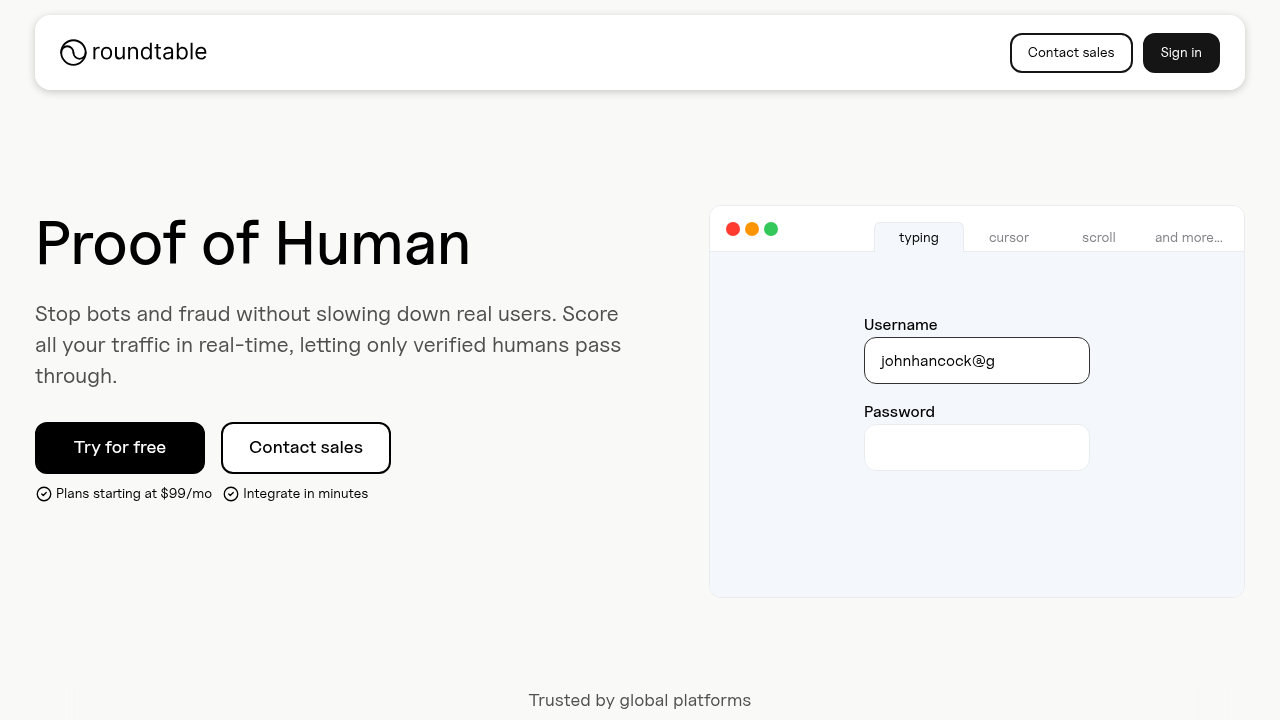
- Roundtable detects bots invisibly through typing rhythms and cursor physics without storing user identities or requiring consent banners.
What are Privacy-First Bot Mitigation Tools?
Privacy-first bot mitigation relies on three technical principles that separate it from conventional detection methods.
First, these tools analyze behavioral signals, not personal identifiers. They look at interaction patterns like cursor trajectories, keystroke timing, and scroll velocity to distinguish human behavior from automated scripts. This behavioral analysis happens in real-time without storing data that could identify individual users.
Second, privacy-first solutions process data locally or ephemerally. Instead of sending user information to external servers for analysis, the detection logic runs client-side or processes data in memory without persistent storage. Any signals collected are immediately discarded after classification, leaving no trail of personal information.
Third, these tools avoid persistent tracking mechanisms. Traditional bot detection often relies on long-lived cookies, device fingerprinting, or cross-site tracking to build user profiles over time. Privacy-first alternatives use session-based analysis that resets with each visit, preventing the accumulation of user histories that could violate
GDPR's data minimization requirements.
The technical architecture matters because privacy regulations like GDPR and CCPA restrict how you can collect, store, and process user data. Solutions that fingerprint devices or track users across sessions may require explicit consent, creating friction that degrades user experience. Privacy-first tools sidestep these requirements by never collecting regulated data in the first place.
This privacy-first approach also reduces your liability. When you don't collect personal information, you can't leak it in a breach, misuse it accidentally, or face regulatory penalties for improper handling. The security posture improves while the compliance burden decreases.
How We Ranked Privacy-First Bot Mitigation Tools
We looked at each tool against five criteria that matter most when you need both security and privacy compliance.
- Detection accuracy. This determines how effectively each solution identifies bots without generating false positives. We weighted tools that catch sophisticated automated threats while letting legitimate users through more than those that didn't. Solutions relying solely on device fingerprints or IP reputation scored lower than those combining multiple behavioral signals.
- Data minimization. This measures how little personal information each tool collects. The best solutions analyze ephemeral behavioral patterns without storing identifiable user data. We penalized tools that maintain persistent user profiles or require extensive cookie consent flows.
- User experience impact. This looks at whether the security mechanism disrupts legitimate visitors. Invisible detection methods that run in the background ranked higher than solutions requiring user interaction like puzzles or checkpoints. We measured how each tool affects page load times and conversion rates.
- Compliance readiness. This assesses GDPR and CCPA alignment out of the box. Tools designed with privacy regulations in mind require less legal review and faster deployment than those needing extensive configuration to meet compliance standards.
- Implementation simplicity. This looks at integration effort and ongoing maintenance. We favored solutions offering lightweight JavaScript snippets and clear API documentation over those requiring complex backend infrastructure or specialized expertise to deploy.
Best Overall Privacy-First Bot Mitigation Tool: Roundtable
Roundtable combines behavioral biometrics with device intelligence to stop bots without asking users to solve puzzles or click checkboxes. The system monitors interaction patterns like typing cadence, mouse movements, and scroll behavior to distinguish humans from automated scripts in real-time. The dual-signal approach delivers 87% detection accuracy, outperforming Google reCAPTCHA at 69% and Cloudflare at 33% in comparative testing. Sophisticated bots that spoof device attributes still reveal themselves through unnatural interaction patterns like programmatic typing or teleporting cursor movements, which
bot detection tools are designed to catch.
Privacy Architecture
Roundtable's privacy architecture follows data minimization principles: it carries out bot identification without collecting names, emails, or any identifiable information. All detection happens in-session with no persistent tracking cookies or cross-site profiles. This design makes it compliant with GDPR and CCPA without requiring consent banners or legal workarounds.
Integration takes minutes through a single JavaScript snippet. The lightweight script captures behavioral data client-side, then the API returns risk scores and fraud signals for each session. You can review detailed analytics through the dashboard or programmatically block suspicious traffic before it causes damage.
Friendly Captcha
Friendly Captcha is a German company offering privacy-first bot protection through proof-of-work technology without analyzing user behavior or storing personal data.
Core Strengths
The system runs computational puzzles in the browser background while users interact with your site. These cryptographic challenges are easy for legitimate devices to solve but expensive for bots running at scale, happening automatically without requiring users to click images or solve visual puzzles. Advanced risk signals supplement the proof-of-work mechanism, adding context about the request without collecting personal information. The solution complies with GDPR by default and doesn't require cookie consent banners. Integration uses a simple JavaScript widget that deploys in minutes.
Limitations
The proof-of-work approach can strain older devices or users on low-powered hardware. Mobile phones and budget laptops may experience slower page loads while the cryptographic puzzle runs, potentially affecting conversion rates for audiences with older equipment.
Bottom Line
Friendly Captcha works well for EU-focused businesses needing strict data residency and regulatory compliance, though it lacks the behavioral intelligence that catches sophisticated bots mimicking human interaction patterns.
ALTCHA
ALTCHA is an open-source bot protection solution built on proof-of-work verification that runs entirely without tracking user behavior or collecting personal data. The system uses cryptographic challenges solved in the browser. You can host the entire verification stack on your own servers without relying on external services, giving you full infrastructure control.
Core Strengths
ALTCHA meets
WCAG 2.2 Level AA accessibility standards and complies with GDPR and CCPA. The proof-of-work mechanism eliminates visual puzzles entirely, removing barriers for users with visual impairments while maintaining bot protection.
Limitations
The absence of machine learning means ALTCHA relies solely on computational costs to deter bots. Sophisticated AI-powered bots with sufficient resources can solve proof-of-work challenges, bypassing the protection without triggering behavioral analysis that would catch unnatural interaction patterns.
The Bottom Line
ALTCHA suits organizations needing on-premise deployment and strict data sovereignty, though it may struggle against well-funded bot operations using advanced AI.
Prosopo
Prosopo is an open-source project that uses browser-based detection with cryptographic proofs to verify users without storing personally identifiable information. The system shares minimal data during verification while blocking automated threats.
Key Strengths
Migration from existing CAPTCHA solutions requires minimal code changes. Prosopo offers a free tier covering up to
10,000 monthly verifications, making it accessible for smaller projects testing privacy-first alternatives. The open-source approach allows you to audit the code and host verification infrastructure yourself, maintaining full control over data flows.
Limitations
This model may lack enterprise-grade support channels and advanced features that commercial solutions provide.
The Bottom Line
Prosopo appeals to privacy-conscious developers comfortable with self-hosting, though enterprise deployment may require more technical expertise than managed services offer.
Cloudflare Turnstile
Cloudflare Turnstile replaces traditional CAPTCHAs with adaptive challenges that distinguish humans from bots. The system analyzes technical signals to verify visitors without requiring interaction in most cases, only presenting challenges when risk signals indicate potential bot activity.
Core Strengths
GDPR compliance comes built-in through minimized data collection. Turnstile also avoids storing extensive personal information, instead relying on ephemeral signals that reset after each session. The system operates independently of Google's infrastructure, removing concerns about data sharing with third-party ecosystems.
Cloudflare's centralized dashboard provides visibility into verification patterns and threat trends. Developer APIs allow programmatic integration across web properties, letting you customize security policies based on your traffic patterns.
Limitations
Independent validation of Cloudflare's detection effectiveness remains limited. While the company reports strong performance, third-party benchmarks comparing Turnstile against behavioral analysis solutions are scarce. The signal-based approach lacks the behavioral depth needed to catch AI-powered bots that mimic human interaction patterns convincingly.
The Bottom Line
The integration of behavioral analysis into their other offerings, like content delivery, make Turnstile ideal for organizations looking for an all-inclusive solution, though those seeking specialized protection may prefer a
Cloudflare Turnstile alternative.
Feature Comparison Table of Privacy-First Bot Mitigation Tools
| Feature |
Roundtable |
Friendly Captcha |
ALTCHA |
Prosopo |
Cloudflare Turnstile |
| GDPR Compliance |
Native by design |
Full compliance |
Full compliance |
Privacy-focused |
GDPR compliant |
| Detection Method |
Behavioral + Device |
Proof-of-work |
Proof-of-work |
Cryptographic |
JavaScript + Fingerprinting |
| User Friction |
Completely invisible |
Invisible |
Minimal |
Low |
Minimal |
| Implementation |
Minutes |
Minutes |
Minutes |
Quick setup |
Integration required |
| Data Collection |
No PII |
No personal data |
No tracking |
Minimal |
Limited data |
| AI Resistance |
Advanced |
Basic |
Basic |
Moderate |
Moderate |
| Real-time Analysis |
Yes |
No |
Limited |
No |
Yes |
Roundtable distinguishes itself through dual-signal detection that combines behavioral and device intelligence, processing each session in real-time without collecting personal information.
Why Roundtable is the Best Privacy-First Bot Mitigation Tool
Organizations face more AI-powered fraud attacks while privacy tools make detection harder. Cookie deprecation also eliminates the persistent identifiers that traditional bot detection relies on, forcing security teams to choose between protection and compliance. Roundtable resolves this through behavioral analysis that needs no personal data. The system processes interaction patterns ephemerally, analyzing each session independently without building user profiles across time.
The behavioral approach catches threats that proof-of-work solutions miss. AI-powered bots can solve cryptographic puzzles but struggle to replicate human typing rhythms and cursor physics consistently. Combining behavioral signals with device intelligence creates multiple verification layers that sophisticated bots must defeat simultaneously.
FAQ
What makes behavioral biometrics more privacy-friendly than traditional tracking methods?
Behavioral biometrics analyze how you interact with a website (i.e., typing patterns, mouse movements, scroll behavior) without collecting names, emails, or identifiable information. These signals are processed in real-time and discarded immediately after classification, leaving no persistent user profiles or tracking cookies that would require GDPR consent.
How do privacy-first bot detection tools maintain accuracy without storing user data?
Privacy-first tools process behavioral signals ephemerally within each session, analyzing interaction patterns like cursor trajectories and keystroke timing to distinguish humans from bots. By combining multiple behavioral and device signals in real-time, these solutions achieve high detection rates (up to 87%) without building historical user profiles or collecting personal information.
When should I choose behavioral analysis over proof-of-work bot protection?
Choose behavioral analysis when facing sophisticated AI-powered bots that can solve cryptographic puzzles but struggle to replicate natural human interaction patterns. Proof-of-work solutions work well for basic bot traffic but may strain older devices and miss advanced threats that have sufficient computational resources to bypass cryptographic challenges.
Can privacy-first bot detection work after third-party cookies are deprecated?
Yes, privacy-first solutions are designed to work without cookies or persistent identifiers. They analyze each session independently using behavioral signals that reset with every visit, making them more resilient to cookie deprecation than traditional bot detection methods that rely on cross-site tracking or long-lived device fingerprints.
Final thoughts on selecting bot mitigation tools
Bot mitigation that respects privacy solves the tradeoff between security and compliance. Behavioral analysis catches sophisticated threats that proof-of-work systems miss, all without collecting identifiable user data. You can protect your site effectively while cookie tracking continues to disappear.